How To Find Your Property On FEMA’s Flood Insurance Rate Maps

What are FEMA flood maps?
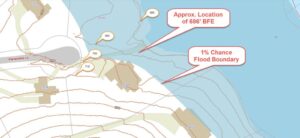
FEMA’s Flood Insurance Rate Maps (FIRMs) or just Flood Maps are provided after a flood risk assessment has been completed or updated for a community.  This study is known as a Flood Insurance Study.  The FIRM gives you the Base Flood Elevations (BFEs) and insurance risk zones in addition to floodplain boundaries.  The FIRM may also show a delineation of the regulatory floodway.

Once the “insurance risk zone”  (commonly referred to as the flood zone) is determined, actuarial rates, based on these risk zones, are then applied for newly constructed, substantially approved, and substantially damaged buildings.  FEMA uses these rates to determine the insurance rate you will pay for flood insurance

FEMA’s Digital Flood Maps

FEMA discontinued the production and distribution of paper flood maps in 2009 as part of its Digital Vision Initiative. This affected all the Flood Maps, boundary information, and study reports. However, clients can still view the products for free through their website or buy them in digital format.

To view these flood maps online, go to FEMA’s Map Service Center and key in your address (hi-lited area shown here) search for your home.  This will prompt you to then select the map that covers your area.  The Flood Maps are somewhat cumbersome to use online. It is best to go through the tutorial on the bottom right of the address search page for an easier and more effective use of the GIS map.


author avatar
Surveyor

More Posts

boundary surveying
Surveyor

Subdivision Survey for Creating Lots Behind a Corner Building

The takeaway is to let a subdivision survey and a zoning check decide what’s possible before you market a lot or sign a sales contract.This guide is for property owners and small developers thinking about dividing land behind an existing corner building. Rules vary by municipality, county, and zoning district,

Read More »

When a Land Surveyor Maps Shared Courtyards in Chicago IL

A courtyard looks simple until something breaks. A cracked walkway, a pooling drain, or a new fence can start an argument fast. Neighbors disagree about who owns what, who pays, and who can build. A land surveyor settles those arguments with facts. The surveyor measures the space, plots the recorded

Read More »
Aerial view of a commercial rooftop with HVAC units and ductwork, illustrating how land mapping drones capture equipment layouts
drone surveying
Surveyor

Land Mapping Drones for Large Rooftop Equipment Surveys

A big commercial roof can hold dozens of units, fans, ducts and pipe runs. The drawings on file rarely match what sits up there today. Land mapping drones give owners and facility managers a fast way to record that layout from above before anyone plans a replacement or a new

Read More »
Surveying equipment set up along a paved road for topo survey fieldwork and site measurements
topographic surveying
Surveyor

Topo Survey for Sites Above Underground Utility Chambers

A new lobby, plaza or addition planned over an underground utility chamber raises a question that plans and aerial photos can’t answer. The architect and engineer need to know where the lids sit, how the ground slopes around them and what the surface looks like today. A topo survey gives

Read More »
Truck parked at a loading dock with multiple dock doors and marked pavement, showing a work area where a construction staking survey may take place
construction
Surveyor

Construction Staking Survey for New Loading Dock Canopies

A new loading dock canopy looks simple on paper. It’s a roof, a row of columns and a connection to the wall. In the field, those columns land in the busiest part of the site, where trailers back in, yard trucks turn and rainwater runs toward the dock. A construction

Read More »