
You submit your plans. You expect a quick approval. Then the city sends them back.
This happens all the time in Chicago. It is not always about design. In many cases, the problem is simple. The city cannot confirm where things sit on your property.
That creates doubt. And when there is doubt, your permit does not move.
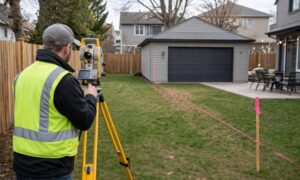
A land surveyor removes that doubt. They measure your lot and show exactly where your project will go. Because of that, your plans become clear, and the review process moves faster.
Why the city needs exact measurements
Chicago is dense. Homes sit close together. Alleys run behind many properties. Because of that, even small errors can turn into bigger problems.
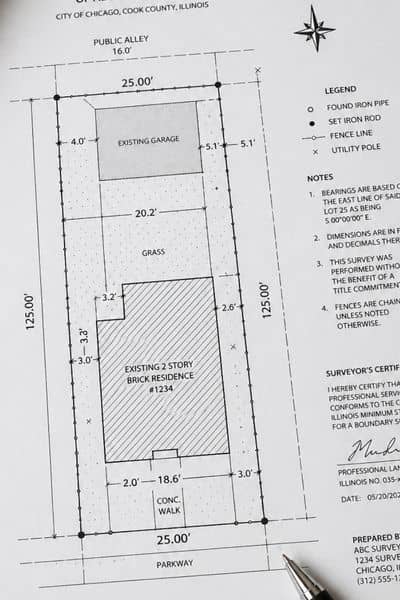
The city checks how your project fits on your lot. They look at how far your structure sits from the edges. They also check how it lines up with nearby buildings.
If your plan is off by even a little, the city will flag it. Then you have to fix it before they move forward.
That is why accurate measurements matter from the start.
Building on narrow lots leaves no room for guesswork
Many Chicago properties sit on narrow lots. Some are only 25 feet wide. That sounds simple, but it is not.
Even a small difference can affect your design. If your lot is slightly smaller than expected, your building may not fit the way you planned.
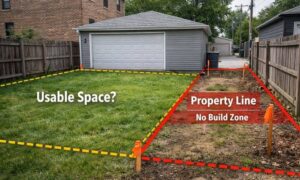
A land surveyor confirms your true lot size and marks the actual property lines. That way, your design stays within limits before you submit anything.
Without that step, you risk going back and changing your plans after review.
Adding a second story still depends on ground accuracy
A lot of owners think a vertical project avoids these issues. After all, they are building up, not out.
However, the city still checks where the existing structure sits. If the base is not in the right place, the addition becomes a problem.
A land surveyor verifies the exact position of your current structure. That helps your plans stay accurate from the ground up.
Because of that, your permit review becomes smoother.
Rear yard projects often create hidden conflicts
Chicago’s alley system adds another layer to many projects. Rear yard work can seem simple, but it often creates issues during review.
You need to know how close your structure sits to the alley. You also need to confirm that it does not block access or cross property limits.
A land surveyor maps the full layout of your lot, including the rear area and access points. With that information, your plans reflect what is actually there.
As a result, the city can review your project without second guessing the layout.
Commercial changes can still trigger survey requirements
Some projects look small on paper. A change in use, a new entry point, or a layout shift may seem minor.
However, these changes can affect how the property works. The city needs to confirm that everything stays within your boundaries.
If they cannot verify that, they pause the permit.
A land surveyor provides clear proof of where everything sits, which helps your application move forward.
Old records rarely match what is on the ground
A cleared lot can feel like a fresh start. Many owners assume they can rely on old records.
That is risky.
Over time, properties change. Structures get removed. Fences move. Small shifts add up.
Because of that, old data may not match current conditions. When the city sees a mismatch, they stop the review.
A land surveyor checks what exists today, so your plans stay aligned with reality.
Skipping a survey leads to delays and extra cost
It is tempting to skip a survey to save money. At first, it seems like a small shortcut.
Then the problems start.
Plans come back with comments. You revise them. You resubmit. The cycle repeats.
In some cases, construction even stops after approval because something was placed in the wrong spot.
All of that costs time and money.
Most of it can be avoided when your plans are based on accurate measurements from the start.
Old surveys are not always accepted
You might already have a survey. That sounds helpful, but it does not always solve the problem.
If the survey is outdated, it may not reflect current conditions. The city often wants updated information.
If your data does not match what is on site, your plans may still get rejected.
A land surveyor can update the measurements so your application meets current expectations.
How a land surveyor helps your permit move faster
A project moves faster when it starts with clear, accurate measurements. In Chicago, that usually means working with a land surveyor in Chicago early, so your plans match what’s actually on your lot.
With that information, your designer can place everything with confidence. The layout makes sense on paper and on site, so the city can review it without confusion.
Because of that, you spend less time going back and fixing things. Delays become less likely, and your project keeps moving.
Instead of guessing, you’re working with real numbers, and that makes the whole process smoother.
When to bring in a land surveyor
Timing matters more than most people think.
If you wait until after you submit your plans, delays can show up right away. Fixing problems at that point takes more time and can slow everything down.
If you bring in a land surveyor early, your design starts with the right data. That keeps things simple as you move forward. It also helps you avoid costly changes later.
If you’re unsure what the process looks like, it helps to read up a bit before you start. You can check altasurveychicago.com if you want to get a feel for it before moving ahead.
Getting your project approved without setbacks
Building in Chicago comes with tight space and strict rules. Because of that, accuracy is not optional.
A land surveyor helps you stay on track. You get clear measurements. Your plans match your property. The city can review everything with confidence.
That leads to fewer delays and a faster path to approval.
If you plan to build, start with real data. It makes every step easier and keeps your project moving forward.