
Chicago never stands still. New towers rise. Old warehouses turn into lofts. Streets get milled and repaved. Utilities get replaced block by block. At first glance, the city may look the same year after year. However, beneath the surface, small shifts happen all the time. Engineers and planners now recognize a quiet reality: parts of major U.S. cities, including Chicago, experience subtle ground movement over time. The change does not look dramatic. You will not see buildings tipping over. Still, even a few inches of settlement or grading change can affect how a site performs. That is exactly why an updated topographic survey has become more important than ever.
Chicago Sites Do Not Stay the Same
Many developers assume that land stays fixed unless someone moves dirt. In reality, urban land changes in small but steady ways.
First, consider aging infrastructure. Crews open trenches to repair sewer lines. They backfill soil. Over time, that soil settles. As a result, pavement and sidewalks shift slightly.
Next, think about street resurfacing. The city adds new asphalt layers. Curb heights change. Alley crowns shift. Those small differences affect how water and vehicles move across a property line.
In addition, freeze–thaw cycles push and pull concrete each winter. Sidewalk panels lift. Driveways crack. Surface slopes adjust.
Meanwhile, infill development continues across Chicago neighborhoods. A new building next door might raise its finished floor elevation. A retaining wall may appear along a shared property line. Even subtle grading work on one lot can influence another.
Because of all these factors, a site surveyed five years ago rarely matches current conditions exactly.
What a Topographic Survey Really Shows
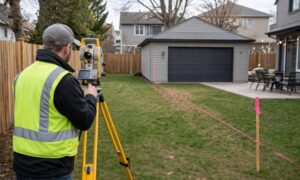
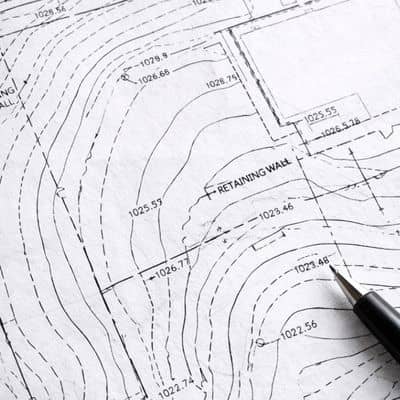
A topographic survey maps the shape of the land as it exists today. Surveyors measure elevations, slopes, and surface features. They record sidewalks, curbs, pavement edges, and visible utilities. They also capture changes in grade across the property.
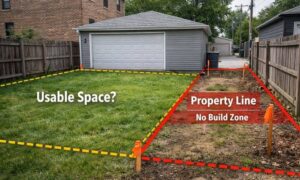
Unlike a boundary survey, which focuses on property lines, a topographic survey focuses on vertical data. That elevation information drives design decisions.
Architects rely on those elevations to set finished floor heights. Engineers use them to design grading plans. Contractors depend on them for accurate construction staking.
Simply put, if the elevation data is off, the entire project starts on the wrong foot.
Small Elevation Errors Create Big Problems
Chicago developments often sit on tight lots. In many neighborhoods, buildings stretch from one property line to the next. Because space remains limited, designers work with very small margins.
For example, imagine a developer plans a garage slab based on an old survey. Later, during construction, the contractor discovers that the alley sits two inches higher than shown. Suddenly, the garage slope no longer meets clearance requirements. The team must revise the design. That costs time and money.
Similarly, consider a residential conversion with basement access. If the survey misses subtle sidewalk changes, the entry threshold may not meet current standards. The architect must adjust stair counts or ramp slopes.
Even a tenth of a foot can trigger redesign.
Therefore, updated elevation data protects the budget and schedule.
City Reviewers Look Closely at Elevations
Chicago reviewers examine grading plans carefully. They compare submitted drawings against site conditions. If discrepancies appear, they ask questions.
When a plan shows outdated curb elevations or missing improvements, the review process slows down. Designers then scramble to explain or correct the data.
However, when a project team starts with a current topographic survey, the plans reflect reality. Reviewers gain confidence. Approvals move more smoothly.
In today’s development climate, fewer surprises mean faster progress.
Infill Development Raises the Stakes
Chicago does not expand outward much. Instead, the city builds within existing neighborhoods. Developers replace old structures. They add stories. They convert single-family homes into multi-unit buildings.
Because of that density, every elevation matters.
For instance, if a neighboring lot raises its grade during construction, it can change how your property connects to shared sidewalks or alleys. Without updated data, you may not notice the difference until construction begins.
Moreover, older surveys may not show new retaining walls or reconfigured driveways nearby. Those features influence how your project ties into surrounding infrastructure.
Infill projects demand precision. Updated survey data provides that precision.
When Should You Update Your Topographic Survey?
Not every project needs a brand-new survey every month. Still, certain situations call for fresh data.
You should strongly consider updating your topographic survey if:
- Your existing survey is more than one or two years old.
- The city recently resurfaced streets or alleys near the site.
- Adjacent properties have undergone construction.
- Utilities were repaired or replaced nearby.
- You plan to add square footage or increase building height.
- You are purchasing property in a dense neighborhood.
In these cases, updated elevations reduce risk early in the design phase.
Modern Survey Methods Improve Accuracy
Fortunately, updated surveys do not require weeks of delay. Surveyors now use advanced tools that improve both speed and precision.
GNSS receivers help tie elevation data to reliable control points. High-density data collection captures subtle grade changes. Digital modeling tools allow designers to integrate survey data directly into CAD and BIM software.
Because of these improvements, teams can gather accurate information quickly. More importantly, they can trust that information when making design decisions.
The Cost of Waiting
Some developers try to save money by reusing old survey data. At first, that choice seems practical. However, hidden risks often outweigh small savings.
If construction crews discover mismatched elevations during staking, work may pause. Architects must revise drawings. Engineers must recheck slopes. Contractors may need change orders.
Delays add up. Redesign fees grow. Meanwhile, financing timelines continue ticking.
On the other hand, investing in an updated topographic survey at the beginning helps avoid those setbacks. Accurate data supports smoother coordination between surveyors, architects, engineers, and contractors.
Chicago Keeps Moving — Your Survey Should Too
Chicago remains one of the most active development markets in the Midwest. New projects reshape neighborhoods every year. At the same time, aging infrastructure and environmental factors continue to influence the ground beneath our feet.
Although the changes happen slowly, they matter.
An updated topographic survey ensures that your project reflects current site conditions, not outdated assumptions. It supports smarter design. It reduces permit friction. It protects your budget from avoidable surprises.
Before you finalize plans, take a moment to review the date of your last survey. If conditions around the site have changed, the safest step forward involves fresh elevation data.
In a city that never stops evolving, accurate information gives you the edge.