

Chicago homeowners are stunned this year. Property tax bills arrived, and many jumped fast and hard. Some homeowners saw increases of 20%, 30%, even 50% in certain neighborhoods. If you’re looking at your bill and wondering how it happened, you’re not alone. And this might surprise you: a property survey can sometimes help you challenge that bill and correct unfair charges.
Yes, really.
A property survey is one of the strongest tools you can use to prove what you actually own, especially when the County’s records don’t match reality. And in Chicago, that mismatch happens more than people think.
Why Chicago Taxes Spiked So Sharply in 2024
This year, Cook County shifted more of the tax load onto homeowners. Commercial buildings in the Loop dropped in value, so a chunk of their tax burden moved to residential properties. That means thousands of homeowners are suddenly paying more, even if nothing has changed about their home or neighborhood.
You didn’t renovate. You didn’t add a bedroom. You didn’t build anything new.
But you’re paying more.
That feels unfair, and for some homeowners, the numbers are unjustified—not because of market forces, but because County data may be outdated or incorrect.
Your Tax Bill Is Based on What the County Thinks You Own
Property taxes are calculated from the County’s internal data.
That data includes:
- the size of your land
- the location of your boundaries
- the square footage of your improvements
- the type of structures you have
- how much usable land is inside your parcel
But here is the problem:
Most of that information is NOT checked in person. It comes from old maps, old plats, GIS approximations, and decades-old files. Sometimes the data is accurate. Sometimes it’s wrong. Sometimes it’s very wrong.
Where Assessments Go Wrong (And Cost You Money)
Over time, issues pile up quietly.
For example:
Old maps may show your lot as larger than it really is. A shared driveway might be recorded as part of your land. A garage could be mapped in the wrong place and counted twice. A fence line might be mistaken as the legal boundary.
And because the County never physically measures your property, these errors stay in the system and affect your taxes year after year.
When they think you own more, you pay more.
Where a Property Survey Changes Everything
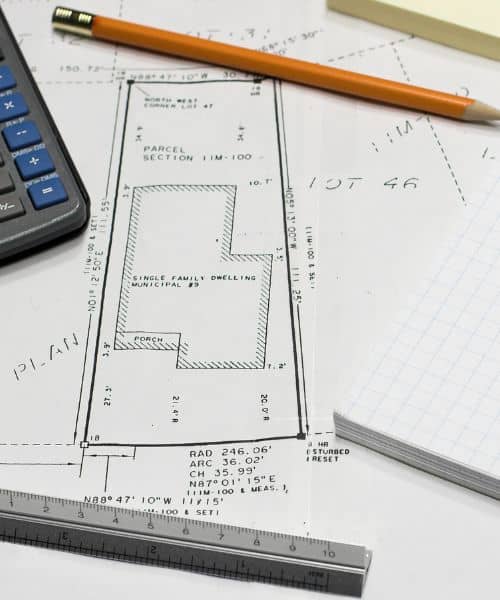
A new property survey gives you a clear, precise picture of your land and structures. It shows what you truly own—not what someone guessed decades ago.
The survey shows:
- exact lot shape and size
- boundary lines
- permanent structures
- setbacks
- encroachments
- easements
- real measurements
When you compare your survey to the County’s records, inconsistencies become obvious fast. And if the County’s data is wrong, you now have proof, not opinion.
Real-World Cases Where a Survey Helps Lower Taxes
Here are situations where a property survey has real power:
Your lot size is smaller than the County says If they believe you have a 4,000 sq ft lot but the survey proves it’s 3,450 sq ft, your assessed land value can drop.
A neighbor’s structure is inside your boundary This can reduce your usable land area.
A shared driveway is counted as yours Many lots deal with this.
A strange-shaped lot treated like a perfect rectangle This skews numbers fast.
Detached garages shown twice Yes, this happens more often than you think.
These mistakes add up.
And over the years? They add up a lot.
When a Survey Will NOT Help
Let’s be honest.
Sometimes your bill increased because:
- the housing market rose
- your area appreciated
- or everyone nearby was reassessed higher
In those cases, a survey won’t change much.
A survey is not magic. But it is the strongest tool available when physical property data is wrong.
A Simple Way to Self-Check Before You Spend Money
Start with a quick comparison.
Look at:
- your tax bill
- your assessor report
- your real parcel shape
- your fences
- your yard layout
- your plat if you have one
Ask yourself:
Do the numbers make sense? Do the lines seem accurate? Does your lot shape match what they show online?
If something feels off, you may be paying for land you don’t truly have.
Many Homeowners Think Something Must Change for Taxes to Drop
But often, it’s the opposite:
Nothing needs to change.
You just need accurate information.
The appeal process is driven by facts.
A property survey gives you:
- data
- measurements
- evidence
- clarity
The County respects documentation, especially from a licensed surveyor.
The Financial Math Most People Miss
Let’s say your annual taxes rise by $2,000.
If the assessment is wrong, and a property survey proves it, you might save:
$2,000 x 5 years = $10,000 $2,000 x 10 years = $20,000
A one-time survey cost is small compared to that.
Your Next Best Step
If your taxes jumped more than your neighbors, or your increase feels out of proportion, or your property dimensions look suspicious…
Don’t ignore it. Look deeper.
You deserve accuracy. You deserve fairness.
Final Thought
This tax spike hit Chicago hard, and many homeowners feel powerless. However, you have options. A property survey lets you see the truth behind your tax bill. It gives you the confidence to question wrong numbers, challenge flawed data, and stand on solid ground when appealing.
You don’t need to accept an unfair increase.
Sometimes, the smartest move is simply making sure the County is taxing the right land.
And the right amount of it.